The False Diagnosis
Businesses Almost Always Blame the Wrong Thing
You’ve tested new creatives. Refined audiences. Adjusted budgets. Leads come in, yet bookings stay inconsistent. So the conclusion feels obvious.
Meta ads don’t work anymore.
The lead quality is terrible.
People click but never buy.
Here’s what most businesses overlook: sometimes the problem is the ads. And sometimes the ads are working perfectly, but the system behind them isn’t.
The real question isn’t simply “Are my ads working?”
The real question is: Where does the system break?
Role Clarity
Ads Only Do One Job, And It’s Not Closing the Sale
Ads have a very specific role inside a marketing system. Their job is to stop the scroll, create curiosity, and generate the click. That’s it. Ads create attention. Conversion happens inside the funnel.
So when leads aren’t converting, two separate problems may exist:
The ads aren’t attracting the right people = The issue starts before the click.
The funnel isn’t converting the people who click = The breakdown happens after the click.
Both are common. They require completely different solutions.
The Breakdown
Where Funnels Usually Break
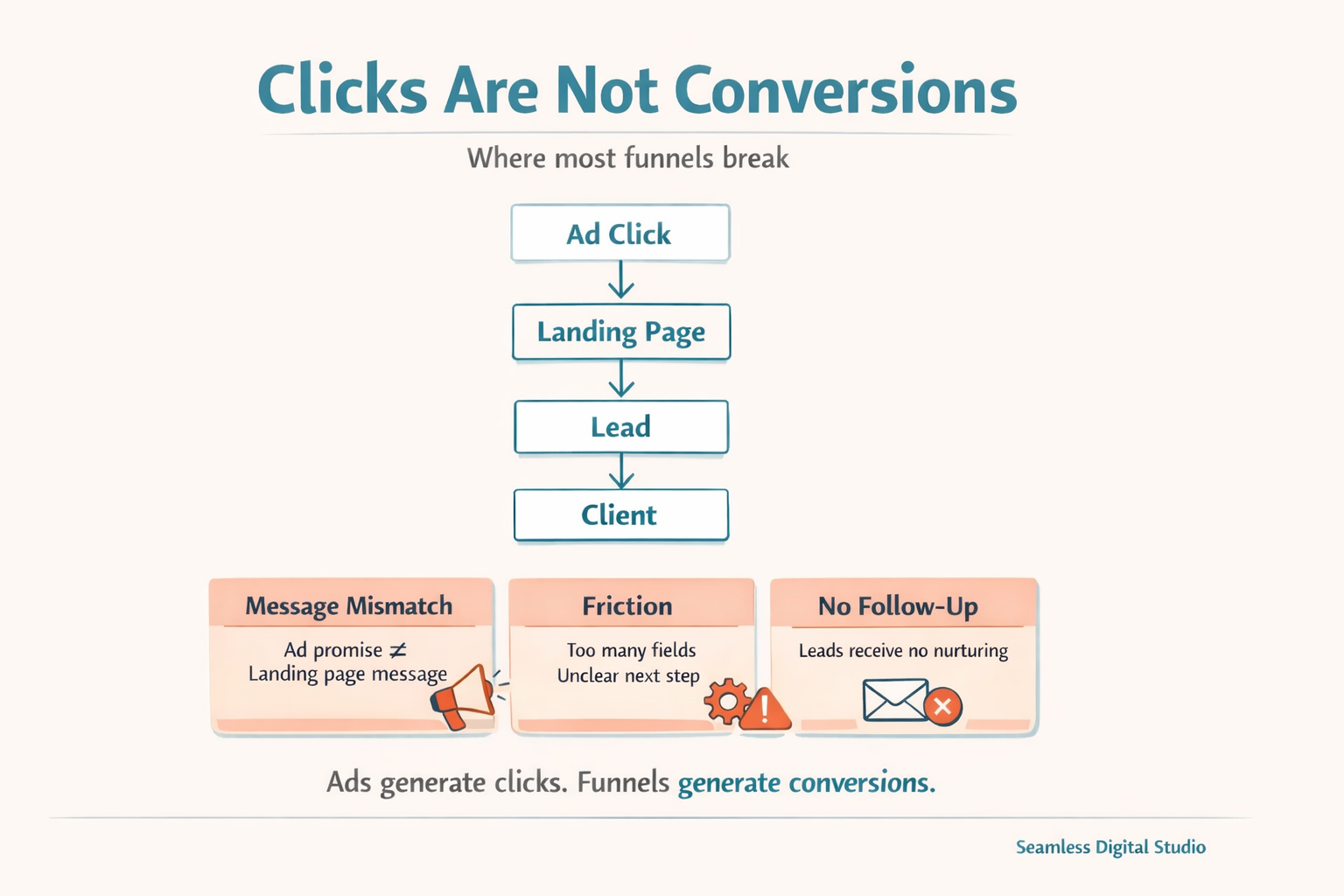
When ads generate clicks but conversions stay low, the issue is almost always structural. In most audits, the same four problems appear repeatedly.
Message Disconnect
Your ad promises one experience. Your landing page delivers another.
The visitor expected one clear next step. Instead, they’re forced to figure out what to do. Confusion replaces clarity. When expectations break, trust disappears fast.
Align the promise in your ad with the experience on the page. The journey should feel like one continuous conversation.
Friction Kills Conversions
Even small obstacles dramatically reduce results. Common culprits:
- Forms with too many fields
- Slow-loading pages
- Unclear next steps
- Vague offers with no defined outcome
Most visitors don’t abandon because they’re uninterested. They leave because the experience feels uncertain or inconvenient. Every moment of hesitation introduces doubt. Doubt quietly destroys conversions.
Simplify the path forward. Make the next step obvious. Remove unnecessary friction wherever possible.
No Lead Nurture System
The most common misconception in marketing: lead = ready-to-buy customer.
In reality, many leads are still exploring options, comparing providers, trying to understand the problem. Without follow-up like email sequences, retargeting, and reminder messages, those leads go cold.
Not because they weren’t interested. But because nothing guided them back.
Build a nurture system that continues the conversation after the first click.
Creative Misalignment
Your ads might be reaching the right people at the right time, but if the creative is not matched to where those people are in their journey, it will not convert. A TOF ad that leads with price or pushes for a booking will repel a cold audience that has never heard of you. A BOF ad that focuses on awareness and discovery leaves a warm lead with no clear next step.
This is one of the most common and most invisible reasons leads don’t convert. The ad works technically, it gets the click, but the message was built for the wrong moment.
Map your creative to the funnel stage it is serving. TOF creative needs to stop the scroll and create curiosity, not sell. MOF creative builds trust, handles objections, and deepens the relationship. BOF creative drives action with clarity, social proof, and a frictionless path forward. A Creative Brief per funnel stage ensures every asset is built for the right audience temperature, not just the right platform.
The Framework
Attention → Trust → Conversion
High-performing funnels don’t treat marketing as a single step. They guide people through a progression. Compressing all three stages into one moment (ad to purchase) almost always drops results.
For service-based brands (coaches, clinics, consultants), this is where cold audiences first encounter your offer through awareness-focused campaigns built around curiosity and reach. For ecommerce brands, this is your Prospecting lane, running interest group targeting and broad audiences to feed the top of the system.
For service brands, this is where nurture lives: retargeting, email sequences, and social proof that move a warm lead closer to booking. For ecommerce brands, this maps to the Scale lane, activated once Meta has collected enough data to identify which audiences are performing and push them harder.
For service brands, the funnel closes here with clarity, testimonials, and a frictionless booking path. For ecommerce brands, this is your Retargeting and Retention lanes: bringing back visitors who didn’t convert and re-engaging past buyers to drive repeat purchase.
People rarely move from stranger to customer instantly. They move through layers of trust. Funnels exist to support that journey. And once the funnel is working, you need to be able to see exactly where each stage is performing. That’s where decision-ready reporting becomes the next essential layer.
Diagnosis
A Quick Reality Check
If your leads aren’t converting, one of two situations is happening:
You’ll typically see:
- Low click-through rates
- Weak engagement
- Inconsistent traffic
The problem begins before the click. The ads themselves need improvement.
You’ll typically see:
- Strong click-through rates
- Steady traffic
- Low bookings or inquiries
Something between the click and conversion is losing the lead. The funnel needs attention.
Without diagnosing the system correctly, businesses waste months optimizing the wrong thing.
The Standard
What High-Performing Funnels Actually Do
The best marketing systems aren’t just campaigns. They’re structured environments designed to convert interest into trust, and trust into action. When different parts of your marketing operate in silos, the whole system pays the price. If that sounds familiar, it’s worth understanding why fragmented marketing is so expensive and what an integrated system actually looks like.
- Message alignment between ads and landing pages
- Focused landing pages built for one clear action
- Retargeting layers that bring interested visitors back
- Email follow-ups that nurture curiosity into confidence
- Creative Briefs per funnel stage so every asset is built for the right audience temperature
- Progressive trust-building through proof, clarity, and education
Want to Know Where Your Funnel Is Actually Breaking?
Most businesses diagnose too late, or optimize the wrong layer entirely. We map the full journey from campaign structure and Creative Brief through to landing page and follow-up, and show you exactly where to fix it first.
Start with the Funnel Blueprint →