
The Problem: Why “Busy Marketing” Still Underperforms
You’re running ads, sending emails, publishing content, and analyzing dashboards. Your team is busy. But at the end of the quarter, the numbers don’t add up. Growth is inconsistent, and you’re not sure why.
Here’s the hard truth: Activity does not equal results. Most marketing teams are drowning in fragmented efforts such as disconnected tools, siloed data, and misaligned goals. You might be generating leads, but if you can’t track their journey or measure what’s working, you’re leaving money on the table.
What Fragmentation Looks Like: A Checklist
Does this sound familiar?
- Your ads team and email team don’t share data.
- You’re guessing which campaigns drive real revenue.
- Reports take hours to compile, and still don’t tell the full story.
- You’re re-acquiring the same customers because no one tracks the full funnel.
- Your campaign structure is flat. One or two campaigns running everything, no separation by funnel stage or audience temperature.
- Creatives are made without a brief. So a cold Prospecting campaign runs conversion-focused ads, and a Retargeting campaign runs awareness content. The mismatch is invisible until performance drops.
If you check even one box, your marketing is fragmented. And fragmentation is expensive.
The Hidden Costs of Disconnected Marketing
1. Repeated Acquisition
Without a unified view, you’re paying to acquire the same leads over and over. Your ads team doesn’t know the email team already nurtured them, so they keep serving ads to people who are already in your funnel.
2. Misread Performance
Blended metrics hide the truth. You think a campaign is performing well, but you can’t tie it to actual revenue. Meanwhile, high-potential channels get overlooked because the data is scattered.
3. Slow, Reactive Decisions
When data lives in silos, you’re always playing catch-up. By the time you spot a trend, the moment has passed. Agility becomes impossible.
The Integration Layer: What to Connect
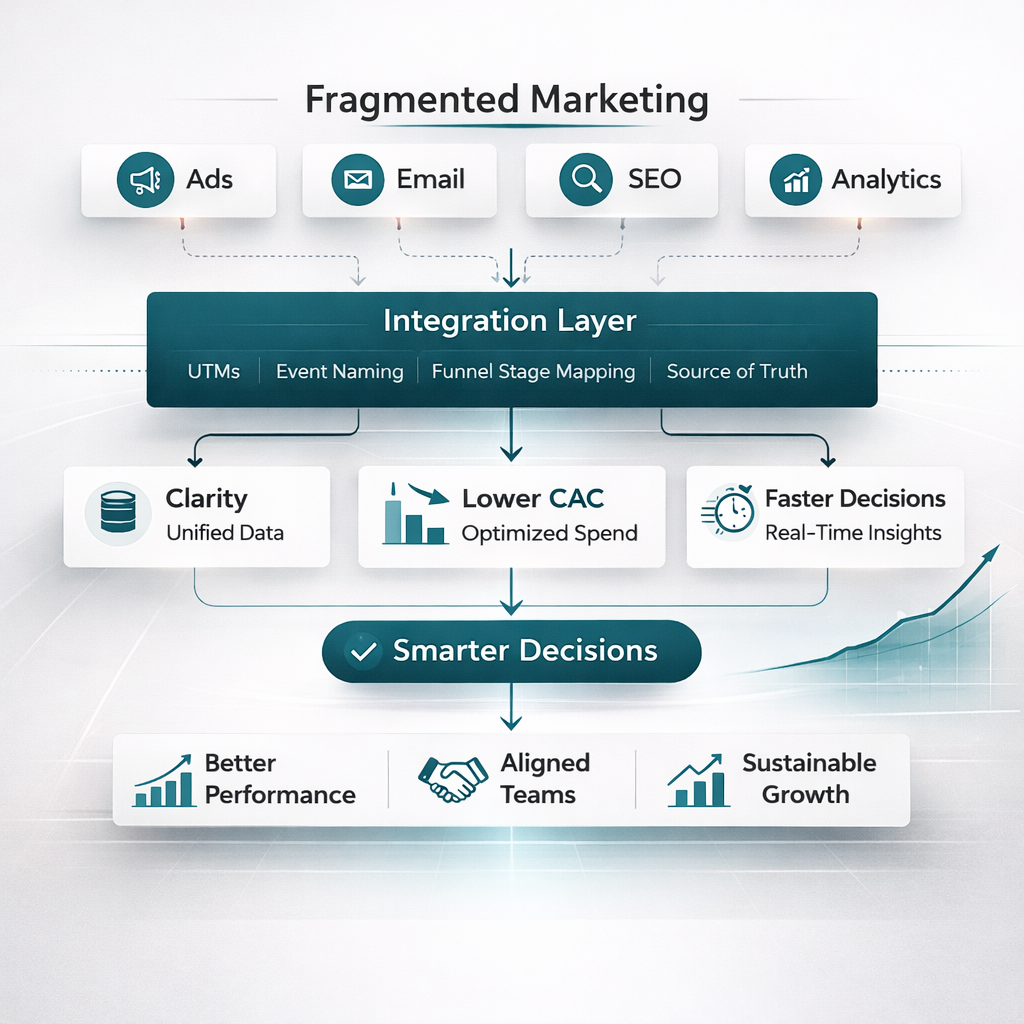
The solution isn’t more tools. It’s a smarter way to connect what you already have. Here’s what needs to talk to each other:
1. Data: UTMs, Event Naming, Source of Truth
- Standardize your UTMs and event naming across all platforms.
- Define a single source of truth for customer data (CRM, CDP, or analytics tool).
2. Funnel Stage Reporting
- Track performance by funnel stage, not just blended metrics.
- Know exactly where leads drop off and why.
3. Email + Retargeting Handoff
- Ensure your email platform and ad retargeting are synced.
- Stop showing ads to people who just opened your email.
4. Campaign Structure and Creative Briefs
- Separate campaigns by funnel stage: TOF, MOF, BOF for service brands. Prospecting, Scale, Retargeting, Retention for ecommerce.
- Brief every creative to its stage. A Prospecting ad and a Retargeting ad are talking to different people. Treat them that way.
Minimum Viable Integration System (MVIS): 5-Step Baseline
You don’t need a massive overhaul. Start with these five steps:
- Audit Your Tools: List every platform and how they connect (or don’t).
- Standardize Naming and Briefs: Align UTMs, event names, and funnel stages. Brief every creative to its campaign stage before launch.
- Centralize Data: Pick one tool as your source of truth (e.g., HubSpot, Google Analytics 4, or a CDP).
- Automate Handoffs: Set up triggers between email, ads, and CRM.
- Build a Live Dashboard: Track performance by funnel stage in real time.
What Changes After Integration
Calm
No more last-minute report scrambles. Your data is always up to date and accessible.
Clarity
You know exactly which campaigns drive revenue and which are just noise.
Control
Optimize in real time. Double down on what works, cut what doesn’t.
Ready to Build Your Growth System?
Fragmented marketing is a revenue leak. But with the right integration layer, you turn chaos into a predictable, scalable growth engine. At SDS, campaign structure, creative briefs, reporting, and email flows are mapped to the same framework before anything goes live.
Want a step-by-step blueprint? Download the Funnel & Marketing Performance Blueprint and start building your integrated growth system today.
Or Explore our Packages here.