
The Problem With “Good Enough” ROAS
You log into your ads dashboard, and the numbers look great. Your Return on Ad Spend (ROAS) is strong… maybe even record-breaking. You pat yourself on the back, confident that your strategy is working.
But here’s the catch: A “good” ROAS doesn’t always mean a healthy ROAS.
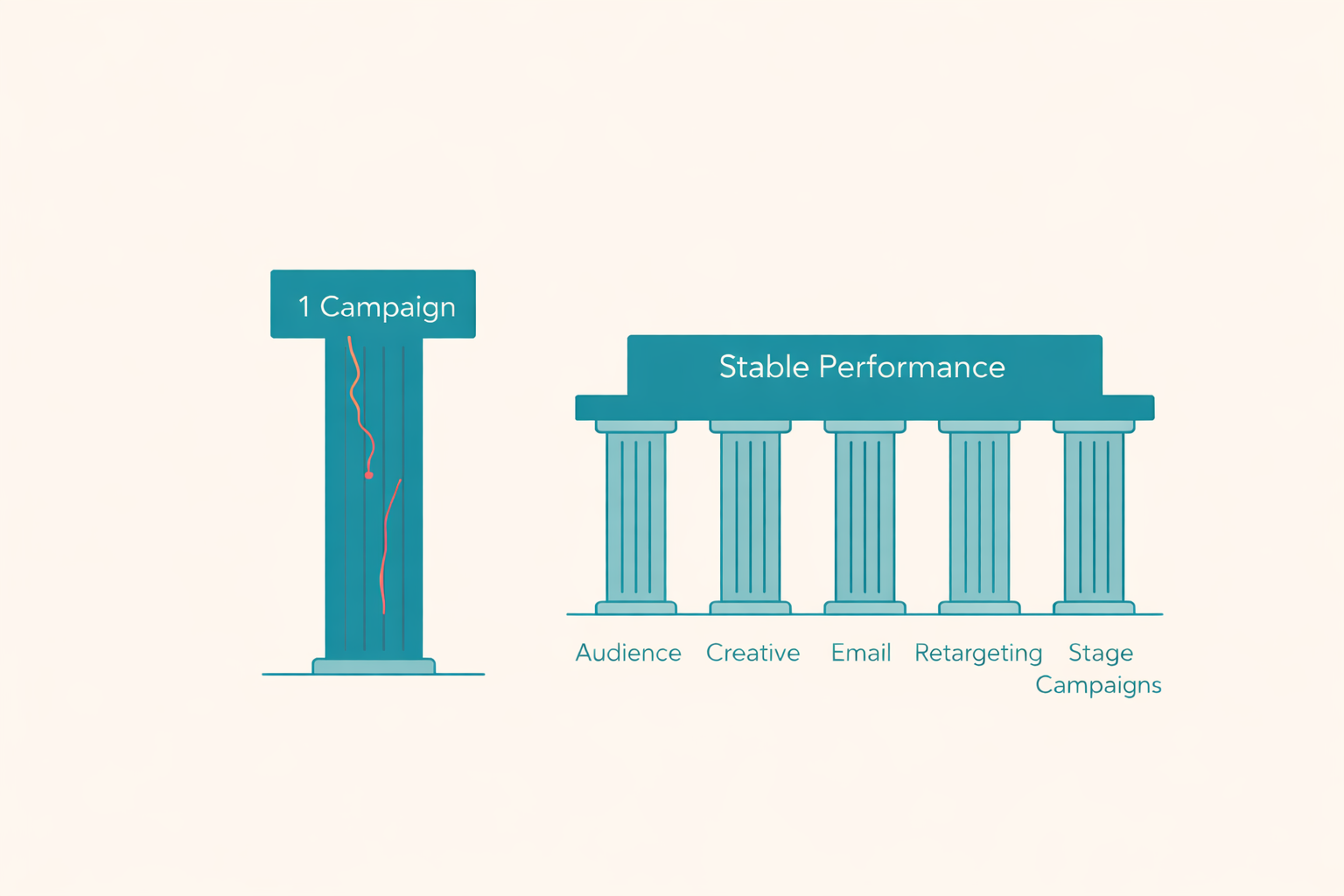
Because what looks like success today could vanish tomorrow– if it’s all riding on one campaign, one creative, or one audience.
This is concentration risk: the silent killer of ad accounts. It’s what happens when your performance isn’t diversified, leaving you vulnerable to algorithm shifts, policy changes, or simple creative fatigue.
And when that one thing stops working? Your ROAS doesn’t just dip… it plummets.
How to Tell If Your ROAS Is Fragile
Take a hard look at your account. Do any of these sound familiar?
- “This one campaign is carrying everything.” (What if it gets flagged or stops scaling?)
- “We’ve been running the same ad for months and it still works!” (Until it doesn’t. Fatigue is inevitable.)
- “Our best audience is just this one lookalike segment.” (What if that segment shrinks or gets too expensive?)
- “We only run ads on one platform.” (Platform risks, like iOS updates or ad policy changes, can wreck you overnight.)
If you’re nodding along, your ROAS isn’t as healthy as it seems.
The Antidote: Build a Structured System, Not Just a Spread
Stable ad accounts are not just diversified randomly. They are structured deliberately around how different audience temperatures behave at different stages of the buying journey.
For ecommerce and Shopify brands, this means running dedicated swim lanes:
🔵 Prospecting targets cold audiences with interest groups and broad targeting. Its job is to fill the top of the system with qualified new traffic, not to convert immediately.
🔵 Scale is a separate, dedicated campaign that only exists for creatives that have already proven themselves inside Prospecting. Once a creative hits the performance threshold in Prospecting, it gets duplicated and placed into the Scale campaign to run at higher budget on its own to maximize the return on what is already working.
🔵 Retargeting brings back visitors who engaged with your content, visited your site, or added to cart but did not purchase. This lane runs with urgency-focused creative and tighter offers.
🔵 Retention re-engages past buyers to drive repeat purchase. It runs the smallest budget but consistently delivers the strongest ROAS in the account.
Each lane has its own budget allocation, and its own success benchmarks. When your Prospecting lane slows down due to audience fatigue or algorithm shifts, your Retargeting and Retention lanes keep the account stable. That is structural resilience, not luck.
For service-based brands (coaches, clinics, consultants), the same principle applies across TOF, MOF, and BOF. A single cold traffic campaign should never be the only thing generating results. Your MOF retargeting layer and BOF conversion campaigns need to be running in parallel so that when one layer softens, the others carry performance while you regroup.
Your 5-Minute Stability Check
Grab your ad account and ask:
| Area | Red Flag | Your Status |
|---|---|---|
| Campaigns | 1-2 campaigns drive 80%+ of results | ❌ Yes / ✅ No |
| Creatives | Same ad running for 3+ months | ❌ Yes / ✅ No |
| Audiences | One segment = most of your sales | ❌ Yes / ✅ No |
| Platforms | All spend on one channel | ❌ Yes / ✅ No |
| Messaging | Only one offer or hook | ❌ Yes / ✅ No |
| Creative Briefs | Creatives are produced without a funnel-stage or lane brief | ❌ Yes / ✅ No |
If you checked ❌ more than twice, your ROAS might be fragile.
How to Maintain Your Results
1. Stop Relying on “The One”
- Campaigns: Allocate 10-20% of budget to test new objectives (e.g., traffic, engagement).
- Creatives: Swap out ads every 4-6 weeks, before fatigue hits.
- Audiences: Layer interests, behaviors, and demographics to avoid over-dependence.
2. Expand Beyond Your Comfort Zone
- Platforms: If you’re all-in on Meta, test TikTok as well.
- Messaging: Run A/B tests on hooks, offers, and CTAs to find what resonates beyond your usual approach.
3. Build a “Backup Plan” Budget
- Always have a small percentage of spend dedicated to experimenting so you’re not scrambling when your top performer falters.
4. Brief Your Creatives Per Lane or Stage
- Creative fatigue is the most common cause of concentration risk after audience exhaustion, and it is the most preventable. The fix is not swapping creatives randomly every few weeks. It is building replacement assets against a Creative Brief that specifies the right hook format, message angle, and emotional register for that specific lane or funnel stage.
- A hook built for a cold Prospecting audience that has never seen your brand will not work in a Retargeting lane where the viewer already knows you and just needs a reason to come back. Briefing creatives properly, with the lane or funnel stage as the foundation, extends the life of your account structure and reduces the frequency of performance drops between creative cycles.
Ready to Strengthen Your System?
If your account feels dependent on a few winning elements, it is time to assess structural risk.
Start with our Mini Ads Offer if you need campaign level stabilization.
Or request a Funnel and Marketing Performance Blueprint if you want full funnel mapping, tracking validation, and a performance architecture rebuild.